
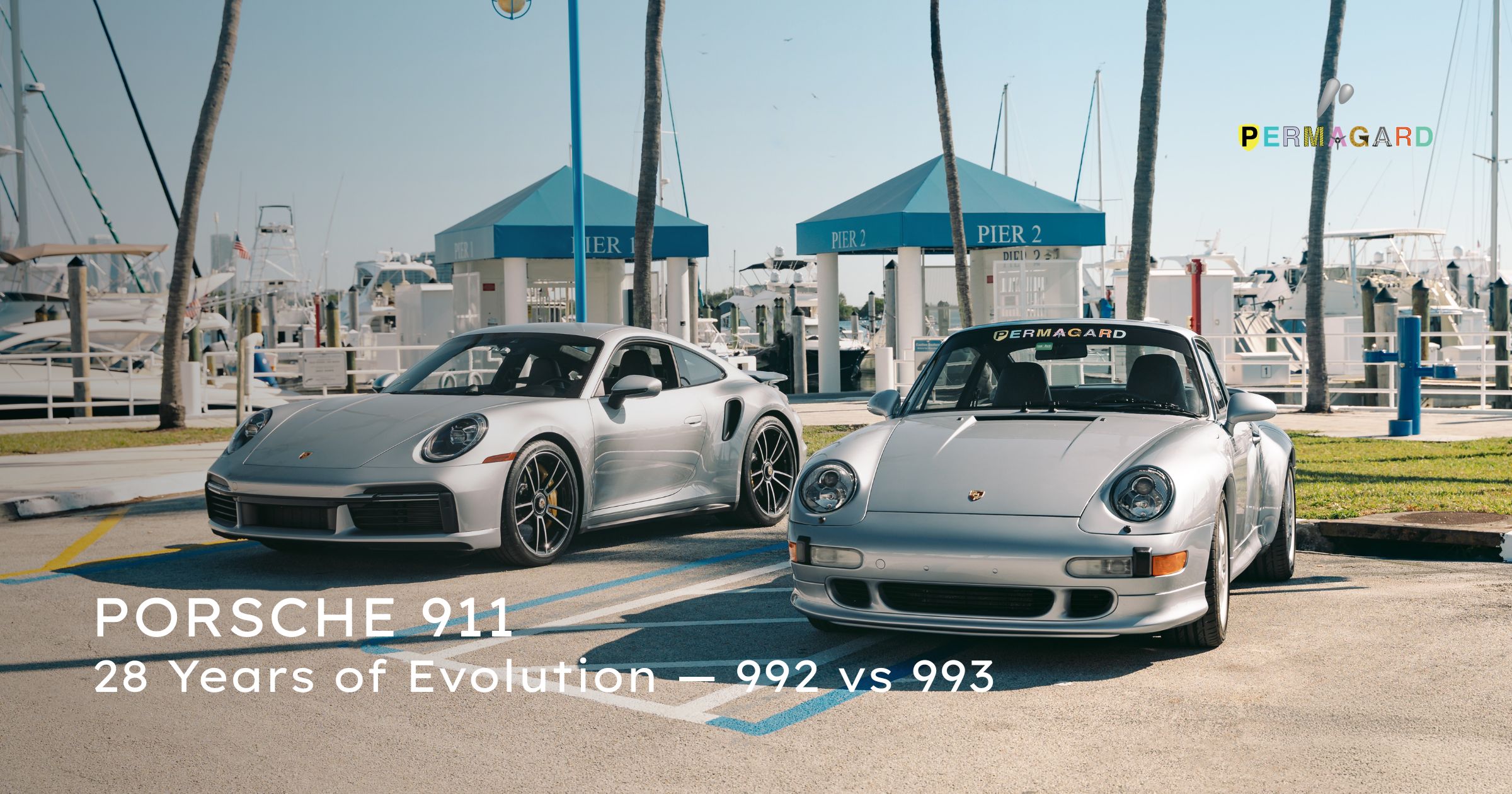
The Porsche 911 is one of the most recognized cars in automotive history. Originally introduced as the “901”, Porsche later changed the name to “911” due to a trademark held by the French manufacturer Peugeot, which had rights to road cars with three-digit model names with a zero in the middle.
These two examples, the 993 and the 992.1, are separated by nearly 28 years.
But what does 28 years really mean in the automotive world?
The 993 — The Last Air-Cooled Analog 911


The fourth-generation Porsche 911, known as the 993, represents the final air-cooled chapter of the 911 and to many enthusiasts, the last truly analog-feeling modern Porsche.
The 993 blends newer technology with the character of earlier icons like the 964, 930, and the original 911.
Our example is finished in Polar Silver Metallic over Midnight Blue interior, equipped with the factory Aero Kit, and is one of only 3,714 Carrera S models produced, a very desirable specification. Not only does it perform, but it also has the looks to match.
Built around Porsche’s “LSA” philosophy (Light, Stable, Agile), the 993 Carrera S is powered by a naturally aspirated 3.6-liter, flat-six, producing 285 horsepower and delivering a 0-60 mph time of about 5.2 seconds through a proper 6-speed manual transmission, of course.
- No traction control
- No Apple CarPlay (unless you retrofit PCCM)
- No USB-C ports
- No giant display taking over the dashboard
Just you, the car, and a mechanical connection.
All that being said, it wasn’t primitive. It introduced Xenon headlights, OBD-II diagnostics, improved seating, and upgraded security systems — the perfect bridge between classic Porsche nostalgia and early modern engineering.
The 992 — Modern Performance, Maximum Capability

Porsche is known for having one of the simplest naming conventions… said nobody ever. But after the 997.2, things became slightly easier with the 991.1 and 991.2, and now with the 992.1 and 992.2, the eighth generation of the 911.
One of the examples we have is the 992 Turbo S, the flagship model, a true gentleman’s supercar. Comfortable enough for the office on Monday, but terrifyingly fast enough for the track on Saturday.
Finished in GT Silver Metallic over black interior, the Turbo S is powered by a twin-turbocharged 3.7-liter, flat-six, producing 640 horsepower. By sending power to all four wheels, it can produce a top speed of 205 mph. In simpler terms, it’s basically a rocket disguised as a luxury car.
0-60 mph in 2.1 seconds… If the right person is driving, of course.
Unfortunately, no manual transmission here.
But the 8-speed PDK (Porsche-Doppelkupplungsgetriebe), super catchy name aka the dual-clutch, shifts faster than any human ever could, so it definitely makes up for the missing third pedal.
Technology in the 992 Turbo S includes:
- Rear-axle steering
- Active aerodynamics
- Porsche Dynamic Chassis Control (PDCC)
- Advanced traction & stability systems
- Adaptive suspension
One moment you’re gliding on the road like you’re on a cloud…, then twist the dial and suddenly the car drops, the spoiler deploys, the turbos pre-spool, and with one button push, the Sport Response boost button launches you into another dimension.
I once drove a Tesla Model S Plaid and a 992 Turbo S on the same day. Yes, the Plaid is slightly quicker… but just because a microwave cooks a steak faster doesn’t mean it tastes better. The “grill”, aka the 992 Turbo S, has flavor, sound, drama, and soul. And the noise it makes on launch will put the biggest grin on your face.

Protected Across Generations — The Permagard Automotive Coating
Despite being nearly 28 years apart, both of these iconic 911s share one important detail — protection with the Permagard Automotive Coating.
Derived from aerospace technology and trusted on aircraft valued at over $70+ million, including Gulfstream jets, Permagard provides:
- Highly durable protection against UV rays and environmental attacks
- Chemical resistance against acidic substances such as bird droppings, tree sap, and acid rain
- Deep, high-gloss finish with a rich “wet-look” effect that increases paint’s contrasts
- Fully compatible on all classic and modern automotive paint systems
And just to clarify — Permagard is not a ceramic coating.
In the automotive world, the word “coating” often makes people immediately think of ceramic. However, Permagard is quite different. No tiny applicator pad, no stressful leveling process, no troublesome flash times, and no long curing windows.
Permagard is applied using a dual-action polisher, making our application process simple, consistent, and effective every single time.
For nearly 30 years, Permagard has been formally approved and trusted by some of the largest aircraft OEMs in the world to protect some of their most valuable painted surfaces. From multimillion-dollar jets to timeless automotive icons like the Porsche 911, Permagard has protected the most valuable painted surfaces across the world since 1998.
If you would like to learn more about how Permagard Automotive can protect your Porsche’s painted surfaces, contact our Permagard Headquarters office today at (305) 662-5070 or email us at info@permagard.com for more information.


Leave a Reply